Jackson Yang (楊信)
Jackson Yang (楊信, born 1944), also written Yang Hsin, is a Taiwanese American entrepreneur and community leader. He is the CEO of Seville Classics, Inc., a globally leading innovator and manufacturer in housewares and storage, generating annual revenue of over $200 million. Seville was awarded “Vendor of the Year” by Walmart. He is also the Chairman of FGB (First Guangfu Bank), a community bank focused on serving small businesses and individuals in Southern California.
Identity Snapshot
- English: Jackson Yang
- Also seen: Yang Hsin. TAH #269 uses Jackson Yang.
- Chinese: 楊信
- Born: 1944, Puxin Township (埔心鄉), Changhua County, Taiwan (year of the end of WWII)
- Family: Youngest of 7 siblings
- Spouse: 何巧玲 (He Qiaoling)
- Education: Elementary school only (dropped out after 1 semester of middle school)
- Core roles: CEO, Seville Classics, Inc.; Chairman, FGB community bank
- Geography: Southern California (Los Angeles area)
- Organizations: Seville Classics; FGB Bank; Taiwanese Chambers of Commerce; World Taiwanese Chambers of Commerce
Early Life
Yang Hsin was born in 1944 in Puxin Township, Changhua County — the year before the end of World War II. His family had 7 siblings; he was the youngest and most pampered. His mother never attended school but was a hardworking rural woman who managed the household with great frugality.
When Yang was in 6th grade, his father died suddenly. The family lost its center of gravity. His mother managed alone, borrowing money from neighbors to pay his school registration fees. She rented out the family’s small plot of farmland and sold the rice harvest to pay debts. Yang’s meals were mostly sweet potatoes with a little white rice — he was too embarrassed to open his lunchbox at school because most of it was sweet potato.
His first real memory of white rice was at a classmate’s temple festival, where he was invited to stay overnight and given a white-rice lunchbox. He still remembers that feeling vividly.
He passed the exam for middle school but attended only one semester before dropping out. He could not bear to see his mother borrowing from neighbors every semester for his fees, and decided to become self-reliant.
First Job: Soy Sauce Factory
His first job was at an uncle’s soy sauce factory in Yunlin, where his main task was washing recycled old soy sauce bottles. The bottles were returned by villagers and were very dirty — they had to be soaked overnight in water, then scrubbed to remove soy sauce residue.
That winter was particularly cold. Yang kept his hands in cold water all day, and they became severely frostbitten — swollen, blistered, and rotting. When he returned home for Chinese New Year, his mother saw his hands and could not bear it. She decided to send him to Taipei to learn trade instead.
Taipei Trade Company
In 1961, at age 17, Yang took a slow train from Yuanlin Station to Taipei — a 5-hour journey standing room only, since it was just after Chinese New Year and the trains were packed.
In Taipei, he worked at a small international trade company on Yanping North Road. The company had only two people: the owner and Yang. His job was to draft English product introduction letters. He also opened and checked the company’s mailbox at the Post Office every morning and evening — international trade at that time used postal boxes as the primary communication address.
The owner’s wife helped another company with bookkeeping. Yang learned the importance of English and, despite his meager salary of 80 NTD per month (less than the 200-300 NTD evening class fee), enrolled at “Melton” (美爾頓), an English cram school.
After nearly 4 years, Yang advanced from a junior clerk to a “small adult” (junior staff). The company specialized in canned food exports — pineapple, orange, lychee, mushroom, bamboo shoot, and asparagus — mainly to Germany and the United States. Taiwanese countryside mushrooms had low production costs, and the profit margin was excellent: about $10+ per box. The company made a lot of money.
Military Service and Independent Business
After military service, Yang’s friend Huang Shicheng (黃石城, later County Magistrate of Changhua) encouraged him to start his own trade company. Yang had no capital, so he organized a “rotating savings association” (招會仔) — 20 people contributing 500 NTD each, totaling 10,000 NTD. With this money, he bought an Underwood typewriter, rented a small office on Chongqing South Road, and began his international trade career.
Immigration to the United States
In 1984, Yang and his wife He Qiaoling visited the United States for summer vacation. Their children loved America so much they said they didn’t want to return to Taiwan. The children’s longing for America, combined with his wife’s “keen insight” about the US, led to a firm decision to immigrate.
Yang’s wife, 何巧玲, first brought the 4 children to the US. Yang remained in Taiwan for two years as an “air traveler” (空中飛人), gradually shifting his business center to America.
In 1986, Yang joined his family in the US and settled down, starting a new chapter of his career.
Building Seville Classics
The Swap Meet Years
When Yang first arrived in America, everything was unfamiliar. Fortunately, his good friend Mr. Lin Jilong (林基龍) and his wife helped them find housing and settle in.
Yang discovered that his company in America, run by a manager, had unsold products堆积 (piling up) in the warehouse. He had to sell them himself — loading products onto his truck and taking them to swap meets (跳蚤市場) every weekend.
He quickly discovered that not all products sold well — there was a gap between supply and demand. “What should I sell?” was the key question. Yang spent two years at swap meets, learning American consumer preferences. He also frequently traveled to Taiwan and China to select products to test the US market.
The Seat Cushion Breakthrough
At a Guangzhou trade fair in China, Yang saw a wooden bead seat cushion — the kind taxi drivers in Taiwan used. He thought: “America has so many cars, but no similar product. This is worth trying.” He bought 2,000 seat cushions for over $10,000.
When he brought them to his American sales representative, he was met with cold rejection: “Americans won’t buy this.”
Yang was discouraged but had no choice — the goods were already shipped. He decided to sell them at the swap meet himself to test the market.
He bought two used car seats from an old car lot, placed the wooden bead cushions on them, and put round bead cushions on top, selling them with the selling points of “cooling” and “massage.” Customers could sit and feel the product firsthand.
The result: the cushions sold incredibly well — dozens per day. Each cushion cost $5 to make, and he sold them for $15.
Comfortbeads and Global Scale
Yang named the product “Comfortbeads” (舒適珠) and packaged them in beautifully designed hard boxes with pictures showing the product installed on car seats. He priced them at $12.99.
He approached BJ’s Wholesale Club, a home goods chain with over a dozen stores on the East Coast. He negotiated a “two-week trial” — if the product didn’t sell, he would take it back unconditionally.
Two weeks after shipping, Yang received a call: the client wanted immediate restocking because Comfortbeeds sold so well, even surprising the store. Yang immediately bought a ticket to China, found the manufacturer, and ordered over 7,000 units. The first shipping container was imported in bulk. Packaging boxes were printed in Taiwan and assembled/shipped from Los Angeles.
After the product became popular, Price Club (the predecessor of Costco) and Walmart also began selling it, opening the entire US big-box store market.
Quality Crisis and Recovery
Not all experiences were smooth. Each seat cushion had over 500 wooden beads strung together with nylon thread by hand. The Chinese-made nylon thread was not strong enough — American customers were larger, and when they sat on the cushions, the thread broke and beads scattered, leading to high return rates that damaged his reputation.
Yang rushed back to Taiwan, found high-quality, strong beef tendon thread, and had it used on the production line. This improved product quality, reduced defect rates, and consolidated his reputation.
At peak, he imported over 200,000 units per week from China. The large volume drove costs down — each unit cost as little as $1.50. He sold to stores for $7-8, and they retailed at $9.99. In 1988-1990, $9.99 was an incredibly cheap product for American consumers, so it sold fast.
Comfortbeads sold 10 million units across the US in 3 years, earning Yang his “first pot of gold” in America and laying the foundation for his business.
Seville Classics, Inc.
Over the years, Yang built Seville Classics, Inc. into a globally leading innovator and manufacturer in housewares and storage. The company generates annual revenue of over $200 million and was awarded “Vendor of the Year” by Walmart.
Banking and Community Leadership
FGB Community Bank
Yang is the Chairman of FGB (First Guangfu Bank), a community bank mainly focusing on serving small businesses and individuals in Southern California. In 2012, FGB ranked first among the nation’s best forming community banks by SNL Financial. As of December 31, 2016, FGB’s total assets exceeded $840 million, operating 4 branches across the Greater San Gabriel Valley and Orange County.
Chamber of Commerce Leadership
- Los Angeles Chinese American Chamber of Commerce: President (2004)
- Taiwanese Chambers of Commerce of North America: President (initiated “Second Generation Assistance” program to introduce young Taiwanese Americans to the real world)
- World Taiwanese Chambers of Commerce (WTCC): President (2013–2014)
- World United Council of Chinese Chambers of Commerce: 20th President (2006)
WTCC Presidency
Yang’s WTCC presidency was marked by grand events:
- 2006 (19th WTCC): Hosted in Hawaii with help from the Hawaiian Chinese Chamber of Commerce. Despite the high cost, Yang covered all expenses. The event coincided with Halloween, and Yang chartered a boat for a sea celebration. Attendees found it unforgettable.
- 2007: Second session in Dallas; annual meeting scheduled for 2008 in Los Angeles.
- 2008 (20th WTCC): Hosted in Los Angeles. Yang organized a three-day, two-night Mexico cruise specifically offering discounted rates for second-generation youth members. Many young members joined, and several couples met on the cruise. Yang served as their wedding witness — a story still told in the community. He was frequently asked to organize similar cruises.
- 2013 (19th WTCC): Hosted at the Grand Hyatt in Taipei. Yang invested $70,000-80,000 to upgrade the stage per the requirements of popular Taiwanese rock band “Power Station” (動力火車), producing a spectacular evening where attendees waved electronic glow sticks. The event was described as “high to the sky.”
TPP Lobbying Trip
One of Yang’s most significant initiatives as WTCC President was the “Washington DC TPP Knock-on-Door Tour” (華府 TPP 叩門之旅).
Understanding the importance of the Trans-Pacific Partnership (TPP) agreement for Taiwan and US shared interests, Yang broke precedent by leading a delegation to Washington DC to meet with US Congress members and officials — instead of the traditional Beijing visits that previous WTCC Presidents had conducted.
The proposal received enthusiastic support from the Overseas Community Affairs Council (僑務委員會), Ministry of Foreign Affairs, Taipei Economic and Cultural Office in Los Angeles, and Washington office.
Thanks to Taiwanese Americans’ strong support for local Congress members, Yang’s delegation had deep relationships. Lawyer Hu Weigang (胡維剛) and his wife provided significant assistance.
Upon arrival at Capitol Hill, House Foreign Affairs Committee Chairman Ed Royce hosted a welcome reception in the House chamber for the delegation, with nearly 30 Congress members attending — a grand and impressive event.
Personal Philosophy
Yang credits his life journey to three sources of help:
- His mother’s love — sent him to Taipei to learn trade
- His wife’s vision — decided to move to America to open new horizons
- A friend’s help — “when far from home, a friend makes all the difference”
He describes his life as having always been blessed by “noble people” (貴人) who helped him at critical moments.
Network
Pages that link to yang-xin (yang-xin):
People (3)
Sources (1)
From the record
-
複核(TJJ-A09251000-9, 2026-09-26):slice 文章 2fc3294ed01f2d2a(Michelle Steel 朴銀珠募款餐會報導, 2025-08-08 快照;同文 8c5d1203 2022-08-13 快照)正文再驗證——與會名單歸屬為真,無錯鏈、無虛鏈;2022-07-02 條目(含該文 wikilink)已在庫 — SKIP,已飽和。
-
覆核(TJJ-A09240600-2, 2026-09-25):slice 文章 20053f0a(耆老講座標籤頁)與 8c5d1203(Michelle Steel 募款餐會報導)正文再驗證——2023-03-14 創業甘苦談影片條目與 2022-07-02 募款餐會發起人記述再確認見於正文,連結為真;對應日期事實已在庫 — SKIP,無新材料。
-
複核(TJJ-A09230700-6, 2026-09-24):本 slice 文章 2fc3294ed01f2d2a(Michelle Steel 朴銀珠募款餐會報導)正文再驗證——楊信為募款餐會發起人並公開呼籲投票支持連任之記述確認見於正文,subject 連結為真,無錯鏈、無虛鏈;2022-07-02 條目已在庫並掛鏈本檔 — SKIP,無新材料。
-
複核(TJJ-A09162345-31, 2026-09-24):slice 文章 20053f0a17b89c07(耆老講座標籤頁)正文再驗證——「第一代台美人創業甘苦談 楊信國策顧問 [影片]」條目再確認見於正文,連結為真;對應日期事實(含該文 wikilink)已在庫 — SKIP,無新材料。
-
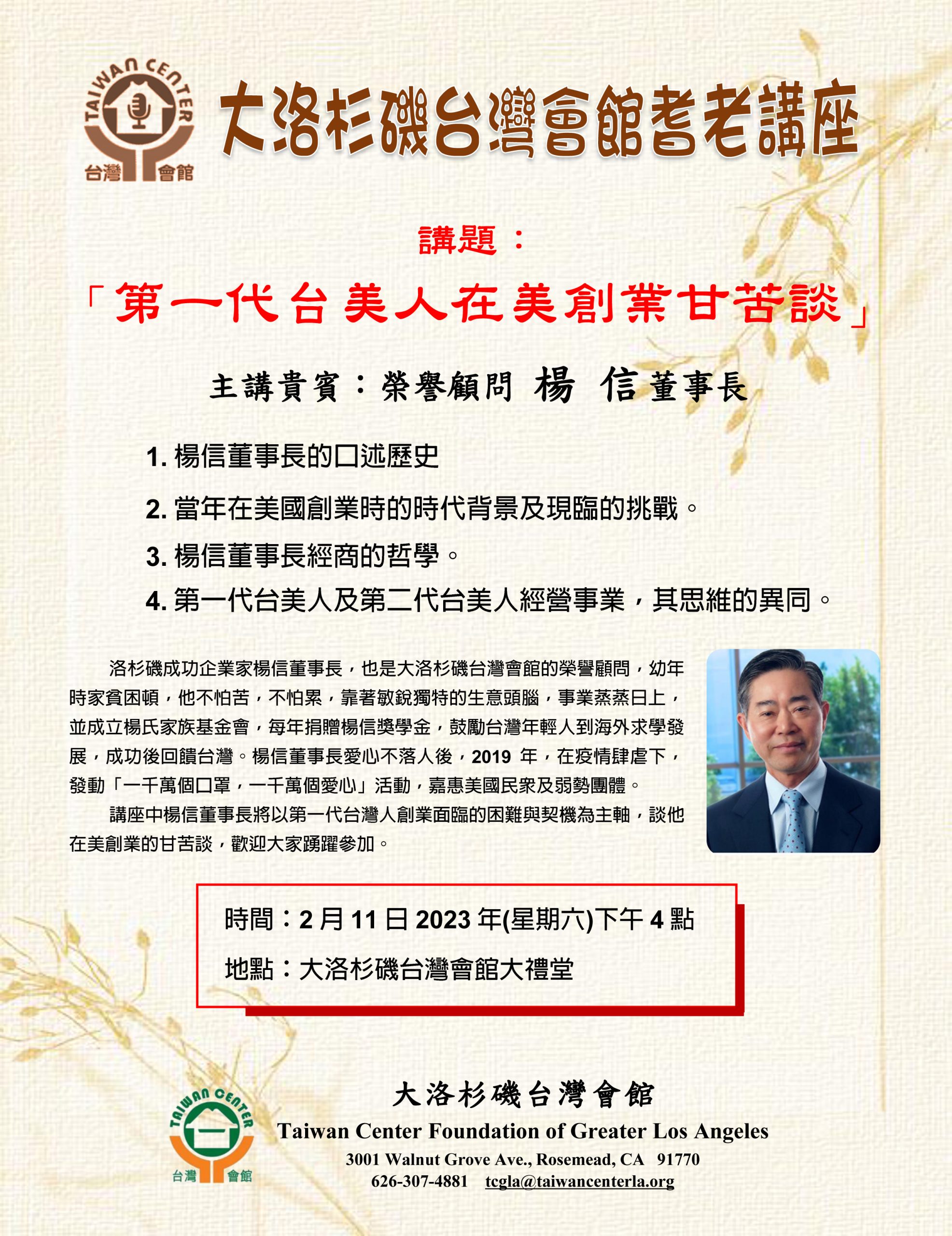
2023-03-14 — 台灣公義報刊「大洛杉磯台灣會館耆老講座第一代台美人創業甘苦談 楊信國策顧問 [影片]」,記其於大洛杉磯台灣會館耆老講座以國策顧問身分分享第一代台美人創業經歷(TJJ 耆老講座標籤頁,2025-02-16 存檔)。
-
2015 — 以「前世界台商會會長」身分與吳澧培、楊黃美幸(台灣民主基金會副執行長)、邱月香(中華軟協理事長)及金門酒廠等合資 3,000 萬元,投資陳玫君紀錄片拍攝(取景台灣與金門)(Our Journeys 279)。
-
2022-07-02 — 以台美人社區領袖身分(率楊信夫婦)於柑縣為國會眾議員 Michelle Steel(朴銀珠)第45區連任舉辦募款餐會,公開呼籲台美人投票支持其連任,稱其親切、關心選民心聲、持續為中小企業主發聲(TJJ, 2022-07-02;另見 2025-08-08 快照)。
-
2012 — 設立「楊信獎學金」,長期協助台灣學生赴美深造,後來擴及 UCLA、UCSD、UCI、Caltech、ArtCenter 等大學;捐助並從一般留學獎學金延伸到飛航專業訓練、國際交流與研究,並成立青年創業基金(美洲台灣日報,蕭錫惠專文,2026-09-14)。
-
2019 — 公開資料顯示相關獎學金規模已超過新台幣1.7億元;公益亦走出校園,長期支持醫院、紅十字會、學校及遊民庇護所等機構(美洲台灣日報,2026-09-14)(reported)。
-
1986 — 移居美國後於跳蚤市場擺攤兩年直接觀察消費者;自廣州交易會見台灣計程車司機使用的木珠坐墊後,第一批進貨2,000個、親赴市場測試,據相關報導三年內售出約1,000萬個(美洲台灣日報,2026-09-14)(reported)。
-
2025-10-03 (sourced) — 駐洛杉磯經文處(處長紀欽耀)在環球影城 Universal Hilton 舉辦114年國慶酒會,近千賓客出席;國策顧問楊信與國策顧問林榮松、羅省中華會館主席聶澤英三人代表僑界上台致詞。楊信推崇台灣健檢便捷經濟、台積電領廠投資鳳凰城與德州使台美人「抬頭挺胸」,並稱花蓮災後兩三日募款逾台幣7億及「鏟子超人」義舉登上國際媒體,是台灣最值得向世界宣揚的「軟實力」(美洲台灣日報 南加社區,記者林蓮華,2025-10-05 刊)。— 美洲台灣日報
-
2019-03-18 (sourced) — TAH 台美史料中心收錄「269. Jackson Yang 楊信」書目紀錄,分類為「Entrepreneur and Community Services」,發表日期 2019-03-18(full text 留 vault,本檔為書目紀錄)([[works/taiwaneseamericanhistory-org/ota-269|TAH #269]])。
-
2026-10-15 (sourced) — 美洲台灣日報(taiwandaily.net)台美人物類別試點歸檔(47 篇存檔,46 ok/1 weak),其 entity index 具名記錄本頁由蕭錫惠專文「創業與回饋人生」吸收創業與回饋事蹟;本頁 2012 設立楊信獎學金、1986 赴美跳蚤市場測試木珠坐墊、2019 獎學金規模逾新台幣 1.7 億元三則以該報為源之條目即出於此次吸收(美洲台灣日報 source)。
Source Notes and Confidence
- Content priority A: 2017 TAHS Publication 行政院政務顧問楊信的創業故事 (The Entrepreneurship Story of State Advisor Yang Hsin), Part 1, L290–884 (~594 lines), written by 黃樹人
- Content priority A: Contains extensive biographical narrative from birth through Seville Classics, chamber of commerce leadership, and TPP advocacy
- Hub: |2017 TAHS Publication
- Note: The full text includes detailed biographical information including family background, early work experiences, seat cushion invention, business growth, chamber of commerce activities, and community leadership.
Family
- Wife: 何巧玲
Related Pages
照片
📷 照片取自公開檔案(來源:taiwanjustice.net,Wayback 存檔 20230119104657)。圖說為原始來源所提供,Echo 未經人工逐張查證——若您認得圖中人,歡迎回報修正。